

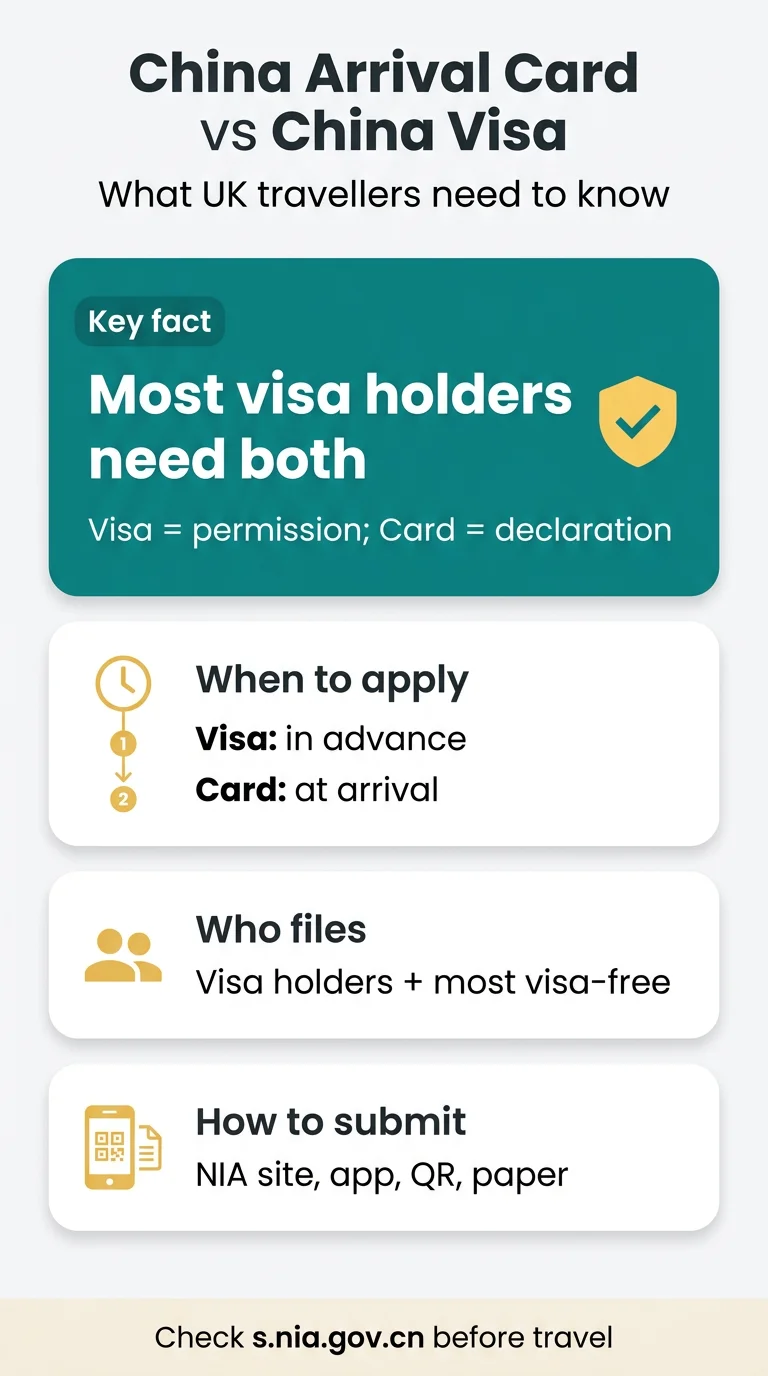
A China visa is permission to enter that you apply for before you travel. The arrival card is a free declaration you file with border officers. The China arrival card vs China visa difference matters because most visa holders need both.
This is an independent guide, not a government site. Check current rules with the National Immigration Administration (NIA) at s.nia.gov.cn before you fly. The facts here come from commercial travel sources. You’ll see who needs which document and how to submit each.
China Arrival Card vs China Visa Difference
A visa gives you permission to enter. The card tells border officers who you are and where you’ll stay. Think of it as permission versus declaration.
| Question | China visa | Arrival card |
|---|---|---|
| Who issues it? | Chinese embassies and consulates | National Immigration Administration |
| Where do you apply? | Applied for in advance, before you travel | NIA digital channels or a paper form |
| When? | In advance, before you travel | Around arrival |
| What do you get? | A visa | A QR code, or a paper form at inspection |
| What does it cost? | Paid | No fee through government channels |
| What does it do? | Permits entry | Declares your entry |
The card can be completed online since 20 November 2025. Most visa-free travellers skip the visa but still need to file the card. For a full overview of the declaration itself, see our complete guide to the China arrival card.
Not sure which one you’re missing? Check the timing row: well ahead means visa, around landing means card.
Who Needs a Visa, a Card, or Both?
Visa holders and most visa-free visitors file the arrival card, and the exemption list covers seven groups.
| Your situation | Visa | Arrival card |
|---|---|---|
| You hold a tourist visa | Yes, you apply in advance | Yes, you file it too |
| You enter visa-free | No | Yes, you still file it |
| You enter under a transit arrangement | Not required where the arrangement applies | Yes, you still file it |
Visa-free and transit rules depend on your nationality and change over time, so check the current list with the National Immigration Administration (NIA) before you travel. If you qualify for the 30-day waiver, read why a visa-free entry still needs a declaration, and if you’re connecting through a Chinese hub, see whether transit passengers need the arrival card.
A port visa (VOA) is an emergency route, not for general tourism. Port visas are issued only at designated ports. You need a host invitation and a reason you didn’t apply at a consulate.
The exemption list covers these seven groups:
- Permanent residents: holders of the Foreign Permanent Resident ID Card
- Hong Kong and Macao residents: non-Chinese holders of the Mainland Travel Permit
- Groups: group visa holders or group visa-free entrants
- Transit and cruise: transit passengers who stay within the designated port area on a direct transit; cruise passengers leaving on the same ship
- Fast-track and crew: E-channel users; crew of international transport
Leaving the airport during a transit? Don’t assume you’re exempt. Hong Kong also has separate visa rules from mainland China. You can read more about who is exempt from the China arrival card, or see the step-by-step process for entering mainland China from Hong Kong West Kowloon.
What to Prepare and What It Costs
Both processes start with a valid passport and your trip details. Visa fees apply, while filing the card through government channels does not require a fee.
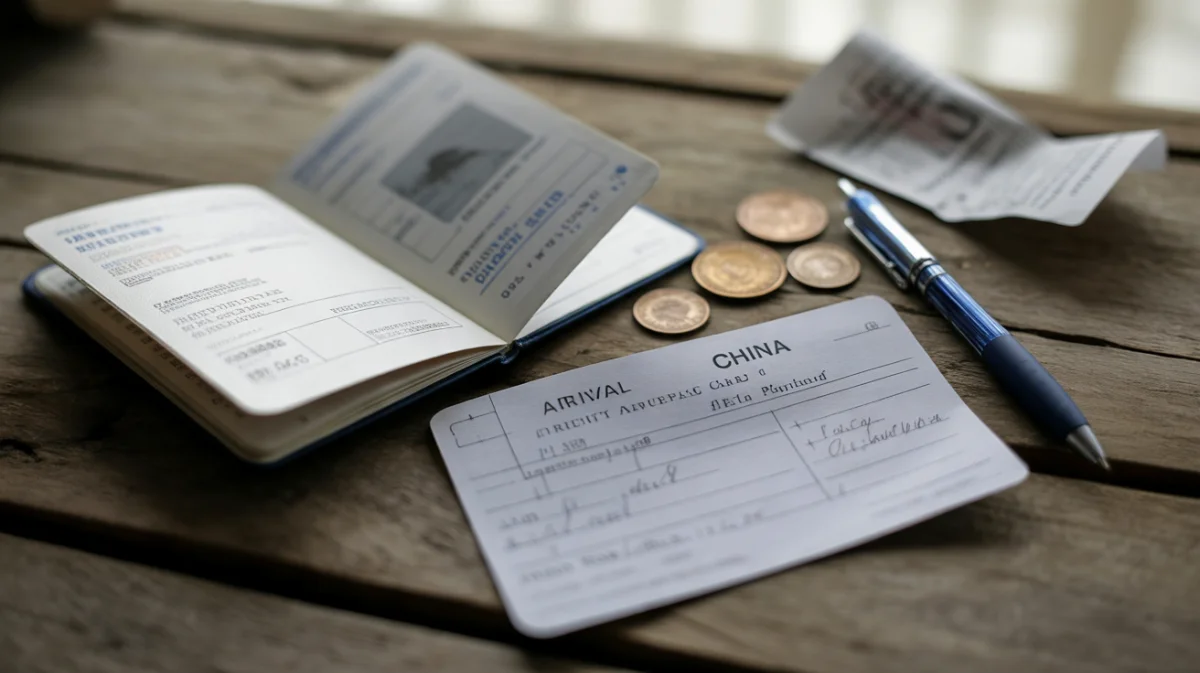
To enter China, your passport should be valid for at least six months after arrival and have at least two blank pages. For the full list of what to have ready, see the documents required to fill the China arrival card.
The card asks for:
- full name as in your passport and passport number
- nationality and flight number
- address in China and intended length of stay
- contact details, travel history and a health declaration
Filing the card through government channels does not require a fee, while visa fees depend on your nationality. Check the current fee information with the Chinese embassy or consulate before you apply.
Some intermediaries charge a service fee to help you complete the card. Enter your name exactly as it appears in your passport.
How to Submit Each Document
The visa is applied for in advance, before you travel. Check the current application steps with the Chinese embassy or consulate.
For the card, these channels are available:
- the NIA website, s.nia.gov.cn
- the government service platform, gjzwfw.www.gov.cn
- the NIA “Immigration 12367” app
- Alipay or WeChat mini-programs
- a QR code scan at the airport
- a paper form at inspection
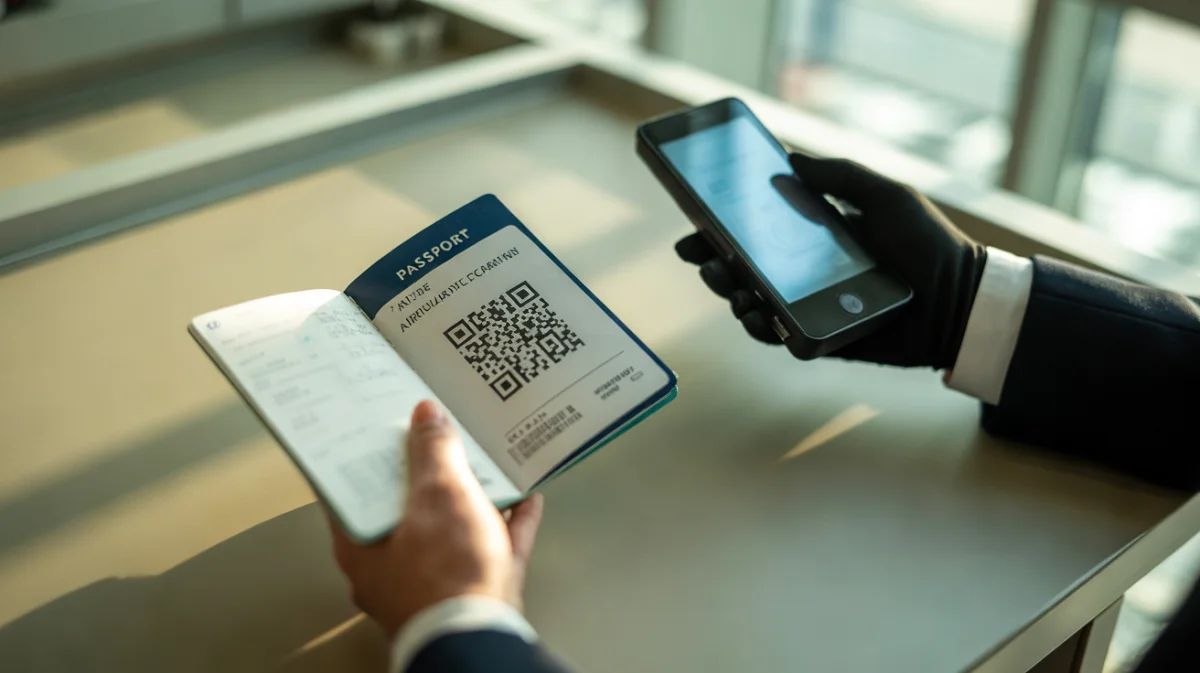
The digital form gives you a QR code that officers scan. A paper form is available at inspection if you cannot use the digital form. We found no reliable source for how early you can file, so check the NIA site. For a walkthrough of the online process, see our guide on how to fill out the China arrival card online.
Border Inspection
Land in China
On landing, officers check your passport and visa
Show your card
Officers scan your card’s QR code or take your paper form
Declaration checked
Your address, contacts and health declaration are covered; exempt groups skip the card
Our sources don’t describe penalties for not filing, so file before you reach the officer.
Common Mistakes to Avoid
- Treating your visa application as your arrival card, or the reverse. They are separate requirements.
- Assuming visa-free or transit status means no card.
- Paying a third-party site for the free card.
- Entering abbreviated names or typos that differ from your passport.
- Assuming visa-free or transit status applies without checking the current nationality list and route rules.
- Relying on your phone with no paper fallback.
- Confusing a port visa with a standard tourist visa.
Our sources are commercial, so check current rules with NIA before you book.
Frequently Asked Questions (FAQ)
What is the China arrival card vs China visa difference in simple terms?
A visa is consular permission to enter, issued before you travel. The arrival card is a declaration of your arrival details, filed with border officers. One grants permission and the other records your entry, so most visa holders need both.
Do I need both a visa and the arrival card to enter mainland China?
Usually yes if you hold a visa. Visa-free and transit travellers usually skip the visa but still file the card. Seven exempt groups exist, such as permanent residents and crew. Confirm your case with NIA.
Is the China arrival card free to submit?
Yes, filing through government channels does not require a fee. Agencies may charge intermediary fees for the same card. A visa is different: its fees depend on your nationality.
Where can I submit the China arrival card online?
You can submit the card through the NIA website (s.nia.gov.cn), the government service platform (gjzwfw.www.gov.cn), the NIA Immigration 12367 app, Alipay or WeChat mini-programs, or by scanning a QR code at the airport.
Who is exempt from filing the China arrival card?
Seven groups are exempt: Foreign Permanent Resident ID Card holders; non-Chinese Mainland Travel Permit holders; group visa or group visa-free entrants; transit passengers who stay within the designated port area on a direct transit; cruise passengers leaving on the same ship; E-channel users; and international transport crew. Confirm with NIA.
What can I do if my phone fails and I cannot show the arrival card QR code?
Ask for the paper form at inspection and fill it in by hand, using the same passport and flight details. Our sources don’t cover penalties, so sort it out before you reach the officer.
Is a port visa (visa on arrival) the same as a normal China tourist visa?
No. A port visa is an emergency route issued only at designated ports. It needs a host invitation and isn’t meant for general tourism. Standard tourist visas are applied for in advance, before you travel.
What is the China arrival card vs China visa difference for transit travellers from the UK?
Transit rules depend on nationality and change over time, so check the current list with NIA. Even where transit is visa-free, you still need to complete the arrival card unless you fall into an exempt group.